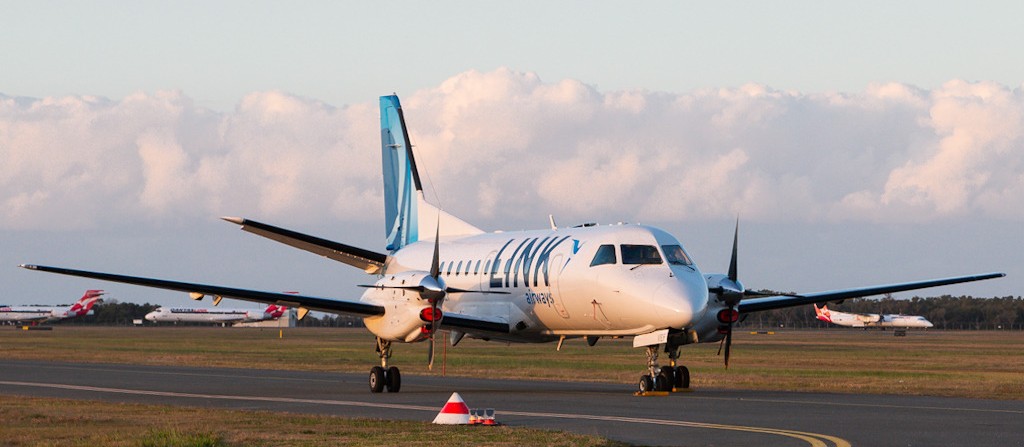
When you board a Link Airways flight at Wollongong Airport, you're stepping onto one of the most respected regional aircraft ever built. The SAAB 340B has been connecting communities across Australia for more than three decades — and it remains the aircraft of choice for the kind of route that WOL operates: short to medium sectors, smaller airports, passengers who want to fly direct rather than drive to Sydney.
It isn't the biggest aircraft. It isn't the newest. But for the Illawarra, it's exactly right — and here's why.
A turboprop designed to do one thing well
The SAAB 340 was developed in the early 1980s as a joint project between Sweden's SAAB and Fairchild in the United States. By the time the partnership ended, SAAB continued alone — producing a family of aircraft that became a staple of regional aviation across Europe, North America, Australia and Asia. Production ran until 1999, with over 450 aircraft built. The B variant, which Link flies, brought more powerful engines, improved hot-and-high performance, and a quieter, more comfortable cabin.
What makes the SAAB 340 well suited to short-haul regional flying is its combination of speed and efficiency at low altitude. Unlike jets that need significant altitude to reach their operating efficiency, the SAAB 340 performs at its best on exactly the kind of one-to-two hour sector between WOL and Melbourne or Brisbane. You spend more time at cruising altitude and less time climbing and descending. For a 400–500 kilometre route, that matters.
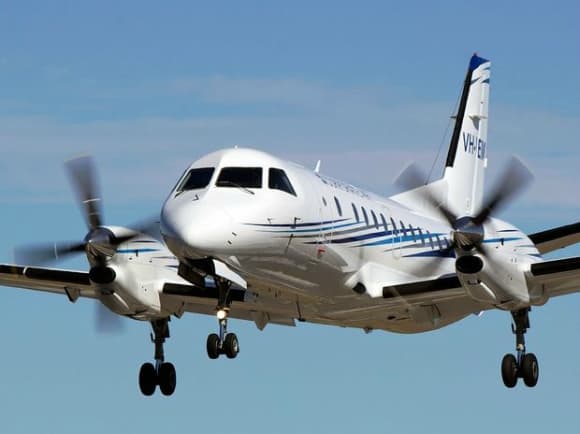
What flying the SAAB 340 is actually like
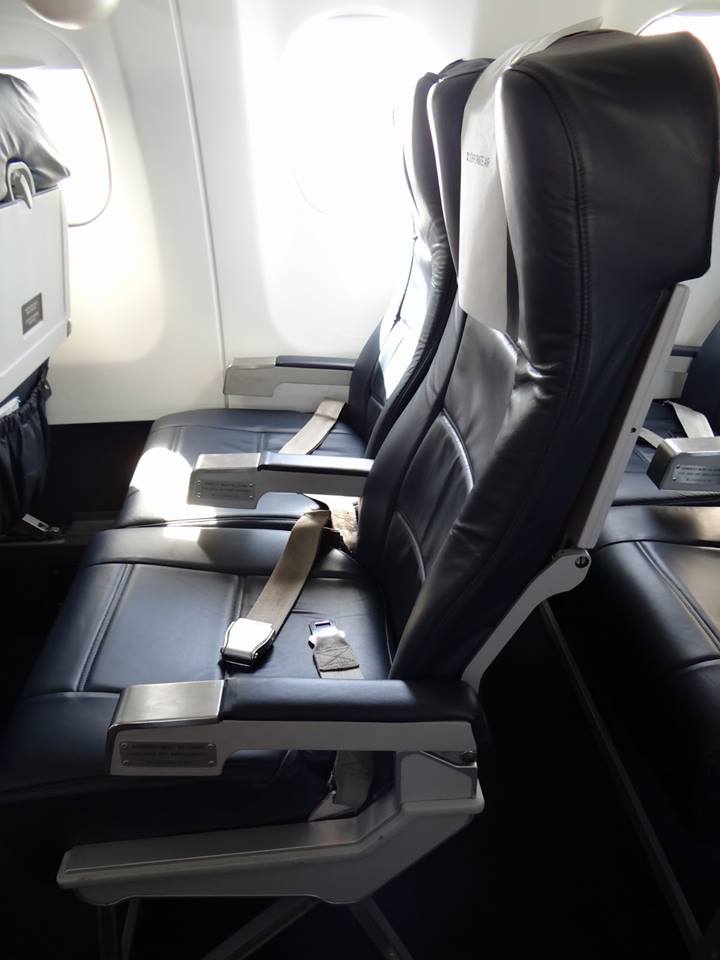
With 34 seats and a single aisle, the SAAB 340 offers something most passengers genuinely appreciate: no middle seat. Every seat is either a window or an aisle. On a commuter service that might carry people travelling for work, health appointments, or family visits, that's not a small thing.
Every seat is a window or an aisle. No middle seat, no compromise.
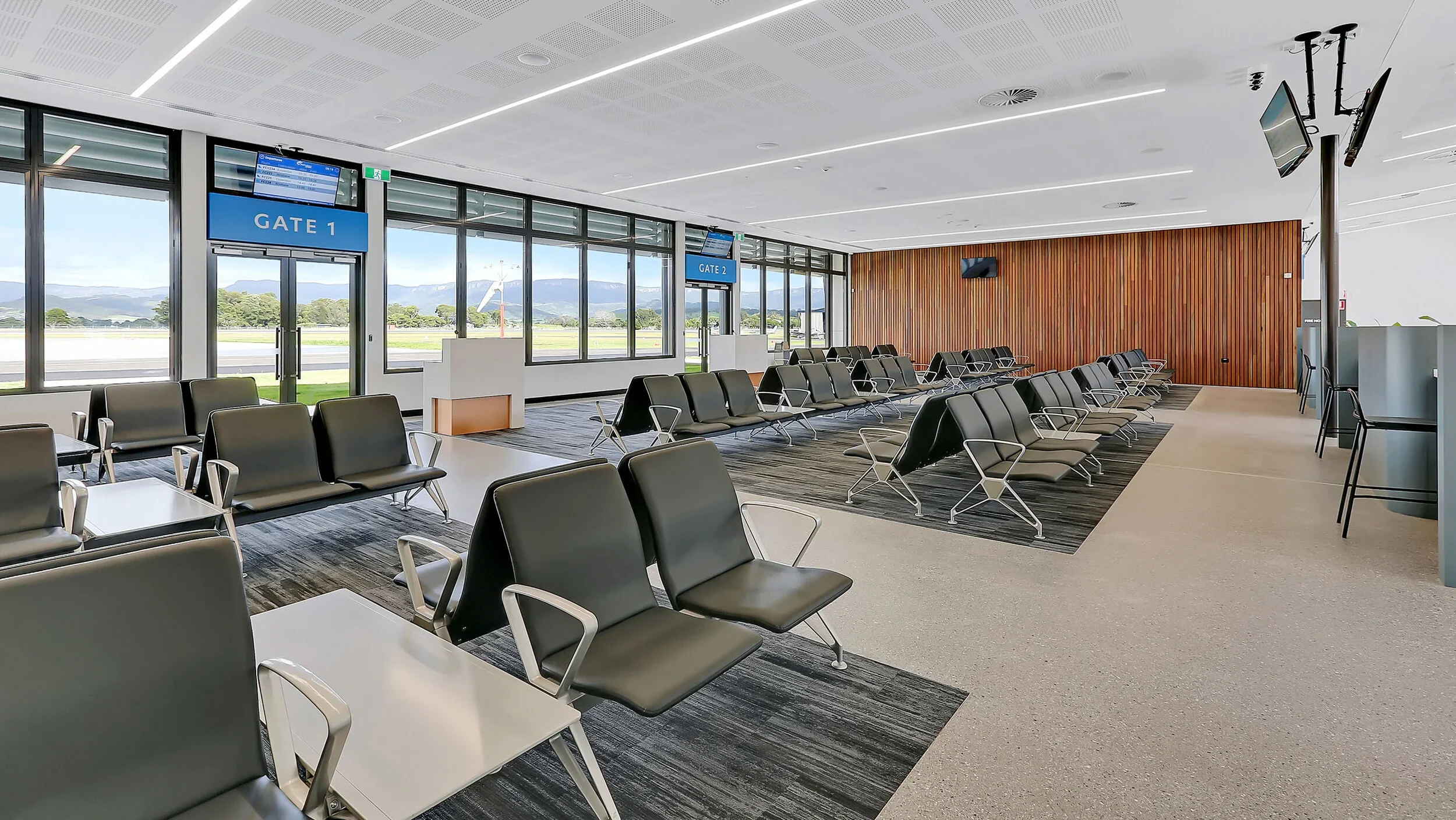
Boarding is direct from the apron — you walk out, climb the stairs, find your seat. There are no jet bridges, no long walks through terminal corridors, no waiting for doors to align. From gate to seated takes minutes. The same is true at the other end. Baggage comes off quickly. You're in your car and on your way before passengers on connecting services at Sydney have reached the kerb.
The cabin is intimate — which is either a feature or a limitation depending on your perspective. The overhead bins are smaller than on a wide-body. There is no inflight entertainment screen. But the flight is short enough that none of that matters. What you get instead is proximity to the flight — the sound of the props, the view from a low altitude, the sense of actually flying rather than being conveyed in a pressurised tube at 38,000 feet.
- 34 seats — all window or aisle, no middle seat
- Direct apron boarding — fast, straightforward, no jet bridge
- Low cruising altitude — better views, less time climbing
- Quick turnaround — baggage off fast, out of the airport faster
- Right-sized for WOL — fills a 34-seat aircraft more efficiently than a 70-seat jet
Why the right aircraft matters for the Illawarra
There is a version of this story where Wollongong gets jet service — a 70-seat Embraer or Bombardier regional jet, the kind of aircraft that operates between Newcastle and Melbourne or Albury and Sydney. It sounds appealing. Jets are faster. They feel more substantial.
But the economics of regional aviation are unforgiving. A 70-seat jet on a route that naturally fills 30–35 seats on each sector loses money every time it flies. Airlines that try it either raise fares to compensate, reduce frequency to fill the aircraft, or exit the route entirely. The history of aviation at WOL includes more than one operator that tried to fly larger aircraft than the market could sustain — and didn't last.
The SAAB 340 is the aircraft that makes the economics work. Link Airways can fill a 34-seat aircraft on the WOL routes at a frequency — four times a week each way — that makes the service genuinely useful. Frequency matters more than size. A direct flight every Monday, Wednesday, Friday and Sunday is worth far more to Illawarra travellers than a larger aircraft flying once or twice a week, or not at all.
There is also the fleet renewal question. As we've written elsewhere on this site, the capital cost of replacing ageing regional turboprops is one of the most pressing challenges in Australian aviation. Government policy has a role to play — but so does the choice of aircraft type. The SAAB 340 has a well-established maintenance ecosystem in Australia, with experienced engineers and available parts. That keeps costs manageable in a way that a more exotic aircraft type would not.
None of this is an argument against ambition. Wollongong deserves more routes, more frequency, and eventually larger aircraft as the market grows. But right now, the SAAB 340 operated by Link Airways is what keeps the Illawarra connected to the rest of Australia. It deserves a little more appreciation than it typically gets.
Frequency matters more than size. Four flights a week in a SAAB 340 beats two flights a week in anything else.