It's one of the most common complaints about flying from Wollongong: the fare. A ticket to Melbourne or Brisbane from WOL often costs more than flying the same route from Sydney. And Sydney is an hour away. It doesn't feel right.
But last week, Qantas submitted evidence to the Productivity Commission's inquiry into regional airfares that should reframe that frustration. Australia's largest airline told the inquiry it makes just 5 per cent profit on its regional turboprop services. Five percent. On a good day. For a company with the scale, the negotiating power, and the maintenance infrastructure of Qantas.
If that's the margin at the top, the economics facing smaller regional operators — like the one that flies from Wollongong — are even tighter. Understanding why helps explain the fare. And it makes the case for why this service is worth supporting, not resenting.
Regional flying is structurally more expensive — by a wide margin
Qantas's submission quantified something that aviation economists have known for years but the public rarely sees in plain language: regional turboprop services cost more than twice as much per seat to operate as a Boeing 737, and roughly three times more than Jetstar's international services.
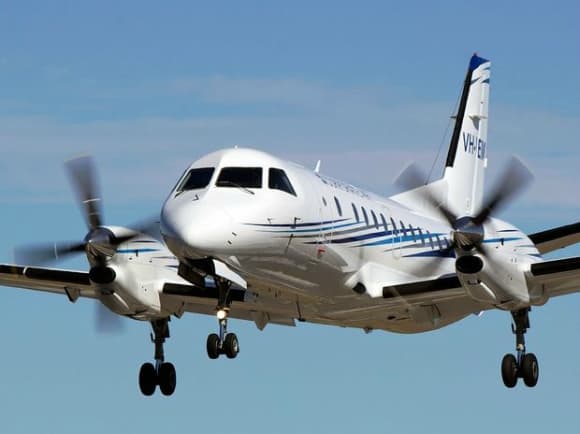
That gap doesn't come from inefficiency or poor management. It comes from the fundamental physics and economics of flying shorter sectors in smaller aircraft. The fixed costs of every flight — crew, insurance, navigation fees, landing charges — are spread across far fewer seats and far fewer kilometres. A 737 flying Sydney to Melbourne carries 180 passengers over 900km. A SAAB 340 flying Wollongong to Melbourne carries 34 passengers over 850km. The cost per passenger kilometre is incomparably higher on the regional service.
| Cost driver | What's happening |
|---|---|
| Spare parts | With 800 Q400s in service and production suspended, parts costs are rising sharply. A landing gear wheel that cost $77,800 in 2019 now costs $148,200 — a 90% increase. Source: Qantas PC submission |
| Engineering | Qantas's turboprop engineering costs rose 19% in 2025 — up from 15% in 2024 and 9% in 2023. The trend is accelerating. |
| Airport charges | Major Australian airports recorded profit margins exceeding 30% in 2024–25, according to the ACCC. Airlines, on the same routes, made 5%. |
| Thin loads | A regional route that fills 28 of 34 seats on average is a good route. The same load factor on a 737 would be a disaster. Fixed costs per passenger are simply higher. |
Link Airways is running a tighter operation than Qantas
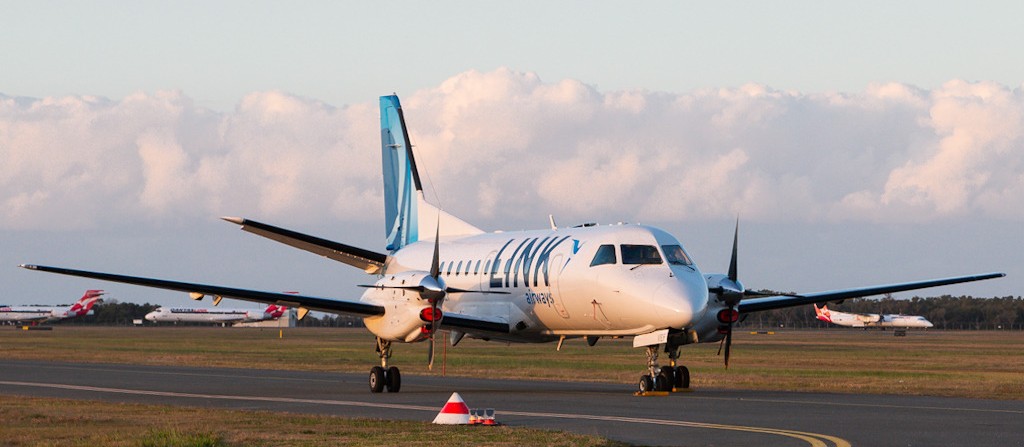
If Qantas — with 43 turboprops, a national engineering network, and decades of supplier relationships — is making 5% on regional flying, Link Airways is operating in an even more demanding environment. Smaller fleet. Fewer routes. Less negotiating leverage on parts and airport charges. More dependence on each individual route performing.
If the biggest airline in Australia barely breaks even on regional flying, the margin for a smaller operator is paper-thin.
This isn't a complaint about Link. It's context. When a WOL ticket costs $369 to Melbourne, that price isn't an attempt to extract maximum value from a captive market. It's the minimum price at which the economics of the service can work. The alternative isn't a cheaper fare. The alternative is no service at all — which is the outcome the Illawarra has experienced more than once in its aviation history.
The value calculation most people get wrong
The comparison people instinctively make is wrong. The real alternative to a $369 WOL–Melbourne fare isn't a $199 Jetstar fare from Sydney. It's a $199 Jetstar fare plus the cost and time of getting to and from Sydney — which for most Illawarra residents means a 90-minute drive each way, $50–$80 in fuel and tolls, and the better part of a day lost to logistics.
Add it up properly and the WOL fare is frequently cheaper — and almost always faster. Park at WOL in ten minutes. Check in. No security screening. Walk to the gate. Board. The entire process from car to seat takes less time than the drive from Wollongong to Sydney Airport.
The WOL fare also includes something the Sydney fare doesn't: certainty. No missed connection. No last-minute terminal change. No 45-minute taxi queue at the other end because your flight landed at T1 and the car hire is at T3. Regional airports are simple by design — and that simplicity has real value.
Airport charges are the most controllable cost — and the inquiry knows it
The Productivity Commission inquiry is the right moment for meaningful reform. The Qantas submission identifies airport charges as the single largest controllable cost on regional routes. When airports make 30% profit margins while airlines make 5%, something is structurally wrong — and it's passengers who pay the difference in their fares.
The Regional Aviation Association of Australia has proposed a Regional Aviation Investment Fund — financed by redirecting a small portion of the Passenger Movement Charge — to provide low-interest finance for fleet renewal and relief from compounding infrastructure costs. The fund would not subsidise fares directly. It would lower the cost base enough that operators can maintain services, invest in aircraft, and — over time — make the economics work at a price point more passengers can justify.
For Wollongong, the stakes are direct. Every time a local passenger chooses Sydney Airport out of habit rather than considering WOL, the load factors that justify the service get thinner. The best thing Illawarra residents can do to keep regional aviation viable is use it.
This article draws on Qantas's submission to the Productivity Commission Inquiry into the Determinants of Regional Airfares (April 2026), available at pc.gov.au. We've previously covered the fleet renewal funding problem in detail — read that piece here.